

Did you know that the population of the Kootenay Development Region is forecast to increase by 12 percent over the next 20 years? Or that there was a five percent increase in the total number of businesses in 2024 from 2023?
The State of the Basin Snapshot Report 2024 gives a data-driven look at social, economic, cultural and environmental well-being across southeastern British Columbia. The annual report, created by Selkirk Innovates, the applied research and innovation arm of Selkirk College, draws on dozens of indicators to help communities understand current conditions and emerging trends.
Read the State of the Basin Snapshot Report 2024
“These data can help our communities plan for the future,” says Jayme Jones, faculty researcher at Selkirk College and project director for the State of the Basin. “Our population is growing, and the average age is projected to rise from 45 to 48 by 2044. An aging population has implications for health care, housing and workforce planning.”
The labour market data tell another important story. While the regional workforce is expected to grow over the next two decades, the current labour force replacement rate is below 1.0. In other words, more people are retiring than entering the workforce. It will take skills training, immigration and retention strategies to avoid substantial challenges for businesses and service providers.
Beyond demographics and employment, the Snapshot Report highlights housing, environmental conditions, education, childcare, homelessness, tourism, recreation and much more. The data come from federal, provincial and local governments, as well as non-profit initiatives and custom data requests.
Insights at a Glance
- Childcare access: There are 4,595 government-supported childcare spaces, up 13% from 2023.
- Environmental conditions: There are 103 red-listed species, and wildfires burned 72,887 hectares.
- Housing: There are 3,528 subsidized housing units, up 6% from 2023.
- Tourism: Over 6 million visitors came to provincial parks in the Kootenay Okanagan region in 2023/24, up 8% from 2018/19 (five-year change).
“Data tell stories about where we’re thriving and where we need to act,” adds Jones. “This snapshot is more than numbers—it’s a tool for communities to plan for a healthier, more resilient future.”
Selkirk College faculty and students carry out the State of the Basin research initiative with funding from Columbia Basin Trust. Access the State of the Basin website at stateofthebasin.ca to explore detailed information on more than 70 indicators of well-being, community profiles and subjective well-being research. You can also subscribe to the State of the Basin Focus newsletter for occasional regional data stories. Residents, local governments and organizations are encouraged to review the findings and join conversations about shaping the region’s future.
Learn more about the Social Innovation Lab at Selkirk College.
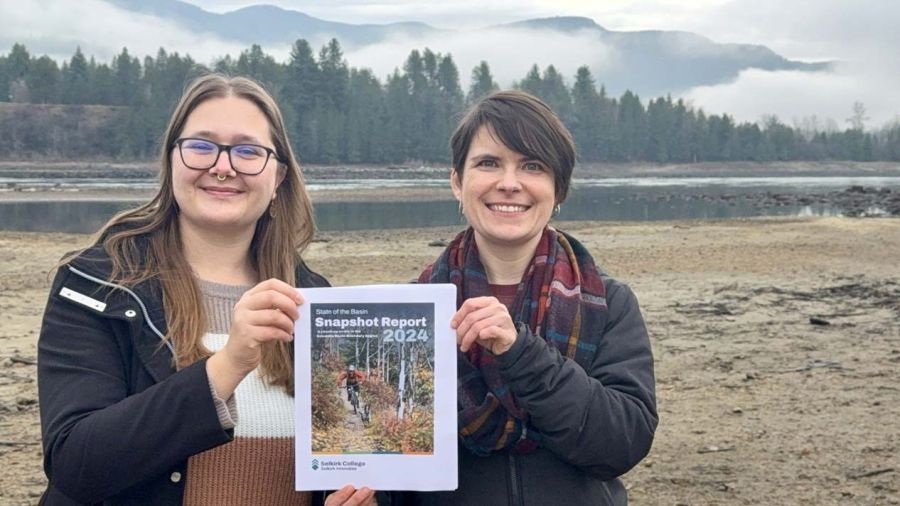
Photo caption: The State of the Basin initiative monitors and reports on indicators of environmental, economic, cultural and social well-being in the Columbia Basin-Boundary Region. Selkirk Innovates compiles the Snapshot Report to provide a summary of current State of the Basin research. Project Director and Researcher Jayme Jones (right) and Research Assistant Leeza Perehudoff (left) show the newly released Snapshot Report 2024.