

The Selkirk College Ion-source Research Centre (SIRC) offers students, faculty and researchers an innovative facility to grow their expertise while driving ion-source technologies forward for the global marketplace.
Contact the Selkirk Ion-source Research Chair Dr. Morgan Dehnel.
Ion-source Innovation
The SIRC drives innovation on three levels.
New technologies
Perhaps the most obvious is that ion-source research is innovation in itself. The research seeks to solve complex issues that have everyday use, such as improving the efficiency in manufacturing semi-conductors found in electric vehicle batteries or better cancer treatments with medical radioisotopes.
Such research falls in line with national mandates, including Canada’s Quantum Strategy and Canada’s Nuclear Science and Medical Isotope strategy.
Further, student and faculty researchers are collaborating with and contributing to broader national and international discovery science and commercial research in the field.
Students
Students from trades apprenticeships to post-doctoral researchers are working side by side to manufacture and build experiments, maintain equipment, identify research opportunities and generate new knowledge.
This breaks down historic barriers between post-secondary programs and allows students to learn from each other’s respective areas of expertise.
Rural geography
Historically, ion-source research has taken place in urban areas at large universities. However, with modern communications, rural geography no longer has to be a barrier to conducting high-tech research—as they are discovering in Chalk River, Ontario, and Oak Ridge, Tennessee.
Our rural region can benefit from ion-source research’s economic drivers, whether they are attracting talent to our growing tech sector, spurring concepts for manufacturing or inspiring new businesses in the area.
Events
The 10th International Symposium on Negative Ions, Beams and Sources – NIBS2026 – will be hosted by the SIRC and will run from September 20–25, 2026 in Nelson, British Columbia.
Facilities & Equipment
Eventually SIRC aspires to be fully operational with four ion-source test stands complete with a full set of beam diagnostic devices so that faculty and students are working with state-of-the-art facilities.
- TRIUMF-licensed volume-cusp negative ion-source test stand (pending funding).
- Penning ion-source test stand donated by D-Pace with related donations from TRIUMF and the University of Victoria. Soon to be operational at the Selkirk Technology Access Centre in Trail.
- Bernas-type ion-source test stand outfitted with the latest in safety instrumentation (pending funding).
- Electron Cyclotron Resonance (ECR) ion-source test stand. A superconducting mass spectrometer for heavy isotope separation is a key diagnostic device, and a smaller portable mass spectrometer that can be fitted to multiple experiments (pending funding).
Research Partners
D-Pace
D-Pace supplies products and services to the international commercial accelerator industry. Their areas of expertise include beamline systems, beam diagnostic devices, and ion sources for research, industrial and commercial accelerator systems.
Since opening a manufacturing and test facility at the Silver King campus in 2018, D-Pace has offered experiential learning opportunities for Selkirk College trade students. D-Pace is a key commercial Mitacs partner of the SIRC.
TRIUMF
TRIUMF, Canada’s particle accelerator centre, supports SIRC’s ability to deliver educational and research opportunities.
As a hub for discovery and innovation, the laboratory houses 600 scientists, engineers and staff, and attracts almost 900 national and international users every year. It provides advanced research facilities and opportunities for 150 students and postdoctoral fellows.
In addition to the onsite program, TRIUMF serves as a key broker for Canada in global research in particle, nuclear and accelerator physics.
University of Victoria
The University of Victoria has a highly regarded Graduate Program in Accelerator Physics, with strengths in physics and theory, but lacks accelerator-based experimental facilities and seeks to foster innovative accelerator and ion-source equipment developments to assist their experiments.
The University of Victoria will provide academic support for advanced degree Mitacs interns.
University of Saskatchewan
The University of Saskatchewan has a highly regarded Graduate Program in Plasma Physics, with strengths in computation, theory and experimentation in areas such as plasma processing for semiconductors, and nuclear fusion. The linkage with the SIRC provides an extension of their plasma capabilities into the plasma realm of ion sources, and collaborations shall lend plasma experience to the SIRC.
The University of Saskatchewan will provide academic support for advanced degree Mitacs interns.
Team Members
- Dr. Morgan Dehnel, Research Chair
- Ben Warfield, Research Intern - University of Victoria, Department of Physics & Astronomy
- Robert Gagnon, Research Intern - University of Victoria, Department of Mechanical Engineering
- Connor MacKenzie, Research Intern - University of Saskatchewan, Department of Physics and Engineering
Research Spotlight
- Clean-Tech Ion Implantation for Next-Generation Power Electronics
- High-Yield Negative Ion Sources for Medical Cyclotrons
Publications
- J.Deguire, G. Fubiani, N. Savard, M. Dehnel, “Scaling of Epsilon-nought in the Particle-In-Cell Code LePIC”, International Conference on Ion Sources (ICIS 2025), Oxford, England, 2025, in press.
- B. Warfield, M. Dehnel, O. Kester, C. Charles, J. Taylor, C. Kent, B. Drew, J. Cramton, T. Junginger, N. Savard, G. Fubiani, “A Penning Ion Source for Stable Isotope Beam Production at TRIUMF-OLIS”, International Conference on Ion Sources (ICIS 2025), Oxford, England, 2025, in press.
- N. Savard, G. Fubiani, M. Dehnel, “Modeling of 1D DC Discharges using Various Particle-in-Cell Schemes”, International Conference on Ion Sources (ICIS 2025), Oxford, England, 2025, in press.
- P. Jackle, K.L. Kavanagh, M. Dehnel, “Production of Negative Helium Ions via Transmission through Nano-Foils”, International Conference on Ion Sources (ICIS 2025), Oxford, England, 2025, in press.
- A. George, S. Melanson, R. Welton, M. Dehnel, “Investigation of an Internal Antenna Design for an RF Ion Source”, International Conference on Ion Sources (ICIS 2025), Oxford, England, 2025, in press.
- G. Fubiani, N. Savard, M. Dehnel, “Particle-In-Cell Techniques to Model Low Temperature Plasmas”, International Conference on Phenomena in Ionized Gases 36th Edition, (ICPIG 2025), Aix en Provence, France, July 20 -25, 2025.
- J. Deguire, G. Fubiani, N. Savrd, A. George, M. Dehnel, T. Junginger, “Comprehensive Modelling of Ion Source Physics with LePIC”, Canadian Association of Physicists (CAP) conference, Saskatoon, Saskatchewan, Canada, June 8 – 13, 2025.
- A. George, S. Melanson, M. Dehnel, “Beam Current Deterioration in a 13.56 MHz RF Negative Ion Source”, Negative Ion Beams and Sources (NIBS’24), I.P.R., Bhat, Gandhinagar – 382428, Gujarat, India, Nov. 19-22, 2024. JINST 20 C05037, May 2025.
Media
2026
News
$3.3 Million Investment Drives Expansion of Selkirk College’s Selkirk Technology Access Centre
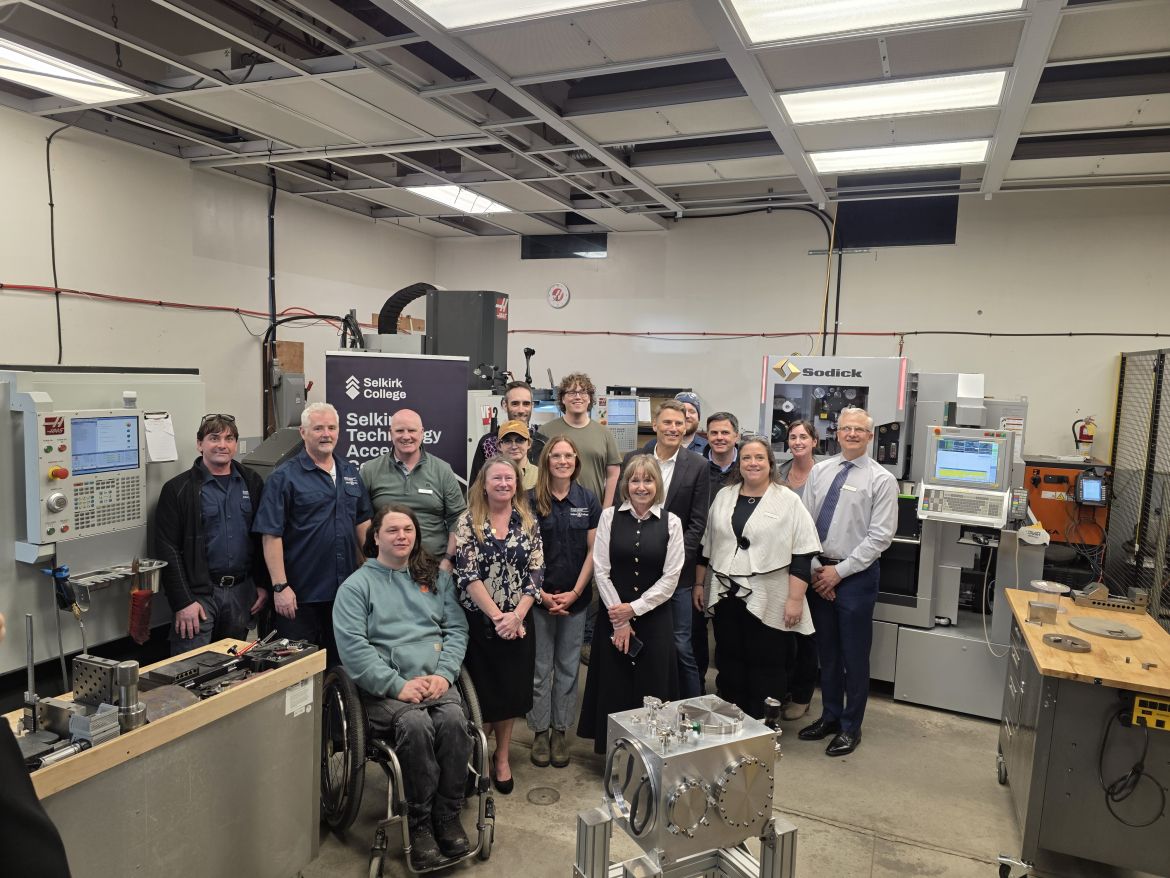
A $1.65 million investment through PacifiCan’s Regional Innovation Ecosystems program is driving a major expansion of Selkirk College’s Selkirk Technology Access Centre (STAC) in Trail, BC. On Monday, March 2, The Honourable Gregor Robertson, Minister of Housing and Infrastructure and Minister responsible for Pacific Economic Development Canada (PacifiCan), toured STAC and announced this federal investment.
Major Donation from D-Pace Fuels Innovation and Education
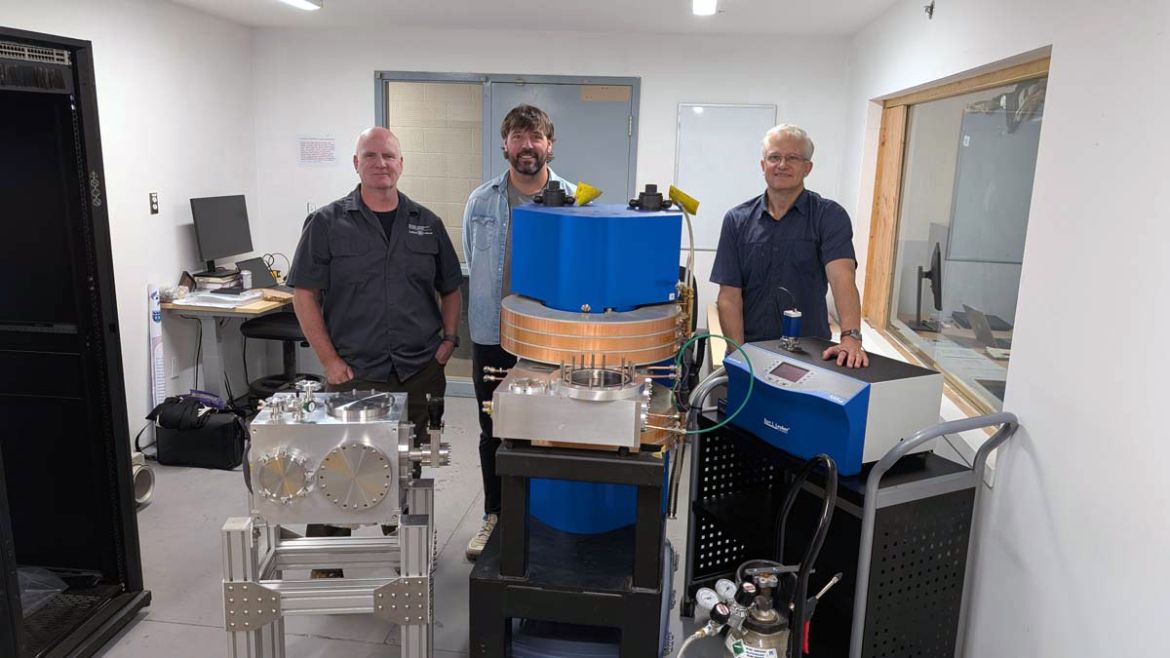
Selkirk College is pleased to announce the establishment of the Selkirk Ion-source Research Centre (SIRC)—a groundbreaking initiative made possible through a generous donation from D-Pace, a Nelson-based leader in the global particle accelerator industry.