

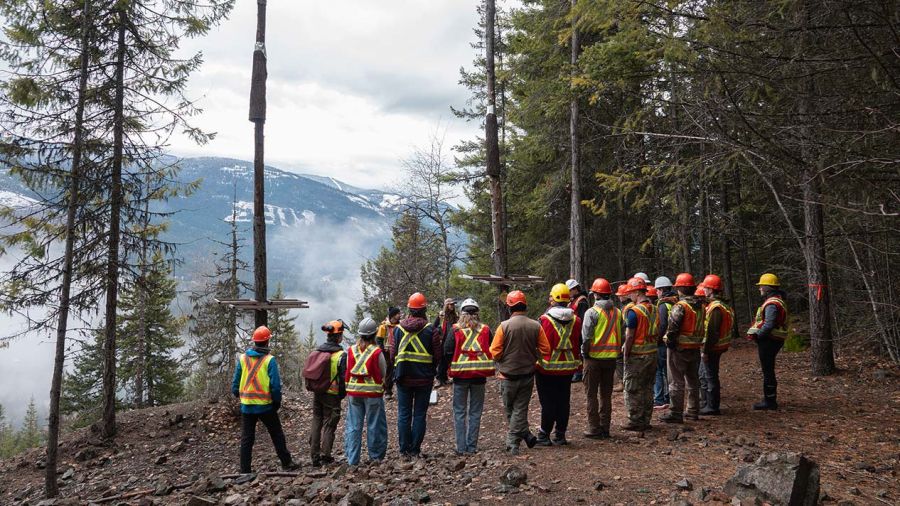
Every winter, instructor Doris Hausleitner takes second-year students in the Recreation, Fish and Wildlife (RFW) Program to Beasley for a hands-on look at a bat conservation initiative led by the Okanagan Nation Alliance (ONA).
The field lab showcases innovative techniques designed to replicate bat roosts in areas where logging has reduced or eliminated critical habitat. This year, students learned directly from Carley Dolman and Marcus Archambault, tmixw (wildlife) technicians with the ONA and graduates of the RFW Program in 2018 and 2023, respectively. They shared both their technical expertise and firsthand experience transitioning from students to conservation professionals.
“Selkirk College was the perfect fit,” says Archambault. “Everything I learned there was directly transferable to my job. There is no substitute for land-based learning. You can read things in a book, but being out in the field—in different ecosystems and habitats—it opens your eyes. You’re looking at what’s around you, making observations and trying to piece things together for yourself.”
Local Land-Based Learning
Students in the Techniques in Wildlife Sciences II course engage in place-based learning throughout the term, pairing classroom instruction with immersive field labs. A selection of field labs includes studying waterfowl ecology at the Castlegar Campus—located at the confluence of the Columbia and Kootenay rivers—conducting a mark-recapture study on bighorn sheep in the Salmo-Creston Pass and examining winter wildlife tracks in Strawberry Pass.
Across localized field sites, students learn current industry protocols and practical field methods, building the skills and confidence needed for careers anywhere in the province or country.
For Hausleitner, the bat lab with the ONA is especially meaningful. Each time the class has done it, the ONA representative has been a program graduate. “It’s so full circle. I get to see students shining in their positions, and they get to give back to a program that they loved,” says Hausleitner. “When current students see graduates in the workforce, they can start seeing their own pathways.”
The collaboration with ONA also deepens students’ connection to place and fosters a genuine sense of responsibility and belonging by grounding their learning in Indigenous ways of knowing, being and doing. Students witness how ONA carries forward the work of the ancestors by caring for the land and all living beings according to principles rooted in traditional knowledge, stories, teachings and ceremonies. “To be thinking about different ways of seeing and knowing outside of the science and technical role has been a goal and a really important step to reconciliation,” says Hausleitner. “It’s a critical piece of students’ knowledge.”