

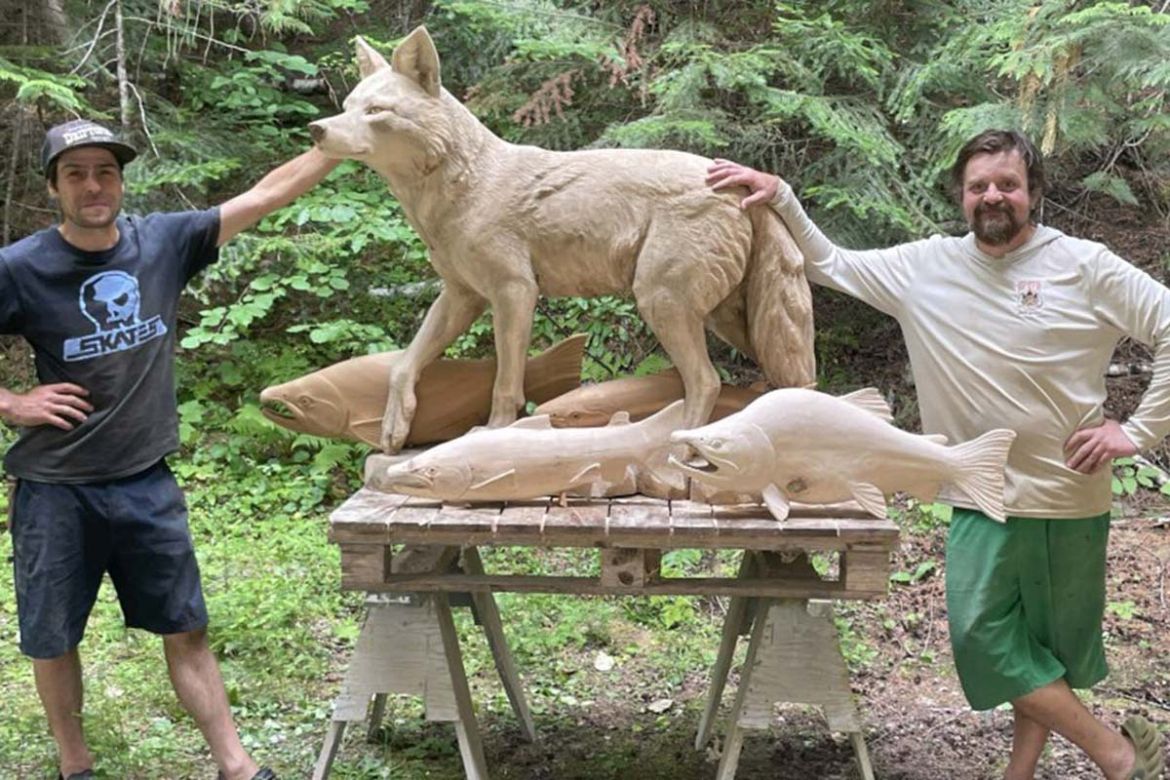
The Coyote Bringing Us Salmon carving is a cultural work intended to deepen community understanding by honouring Indigenous origin stories, strengthening awareness of the ecological significance of Salmon reintroduction to the Columbia River and illustrating collaboration as a shared journey of mutual benefit.
It was crafted by talented Blackfoot artist Chad Thompson in collaboration with acclaimed Russian carver Dmitrii Klimenko.
The carving depicts an Indigenous origin story of Coyote bringing Salmon to the Columbia River Watershed Nations.
About the Artists
Chad Thompson
Chad Thompson lives in the Slocan Valley with his teenage son, Kintan. Chad is an outstanding carpenter and contractor, those skills are only surpassed by the diversity and excellence of his artistic skills.
Chad grew up on a ranch bordering Kananaskis country in Alberta. At a young age, he learned a great respect for Mother Earth and was inspired daily by the vast wildlife and beauty of his surroundings. Drawing pride and inspiration from his Native ancestry, he hopes to enlighten people to the beauty and sophistication of First Nations culture and tradition. Never being schooled in art, Chad feels he is influenced constantly by his surroundings: "Mother Earth is the greatest teacher."
Chad has been given opportunities to work with experienced artists and has gained extensive knowledge and experience in mural painting, sculpture, graphic and logo design. Chad works mainly with acrylic paints but also indulges in antler, stone, wood sculpture, jewelry design, artifact reproduction and replicas, hide painting, leather work, fine woodworking and carpentry. As a nature enthusiast he spends time in the Kootenay’s enjoying fly fishing, bird watching, ski touring and paddling.
Chad considers his talents God-given and gives thanks to the creator for his abilities; thanking those who have given him support and guidance throughout his career.
Dmitrii Klimenko
Dmitrii Klimenko is a sculptor born in 1979 in Rostov-on-Don, Russia, who graduated from the Saint Petersburg State Academy of Art in 2004. He began sculpting sand that same year after a chance opportunity at a local competition, which led him to make it his primary medium alongside his
initial work in traditional materials like bronze and wood. He has participated in international sand and ice sculpture festivals in over 15 countries.
In his early career, Klimenko initially focused on monumental sculpture for public spaces.
Shift to Sand
He discovered sand sculpture in 2004, which became his main artistic medium due to its unique creative possibilities.
Education
He graduated in 2004 with a master's degree in Monumental Arts from the Saint Petersburg State Academy of Industrial Art and Design. International career: He has participated in numerous international sand sculpture festivals across the globe, including in Japan, Canada, the USA, Kuwait, and Belgium.
Other Media
In addition to sand, he also works with other materials such as ice, bronze, and wood.
About the Carving
Cultural Significance
Born from a cross-cultural collaboration, the carving connects people to one another and the land.
Learn more
By bringing an Indigenous origin story into form—where Coyote is often understood as a teacher and transformer —it centres the cultural and spiritual importance of Salmon as relatives, not just resources, while drawing attention to ongoing restoration efforts in the Columbia River.
In doing so, it celebrates and carries forward Indigenous knowledge systems and living traditions. It stands as a lasting expression of partnership, learning, and respect.
Ecological Significance
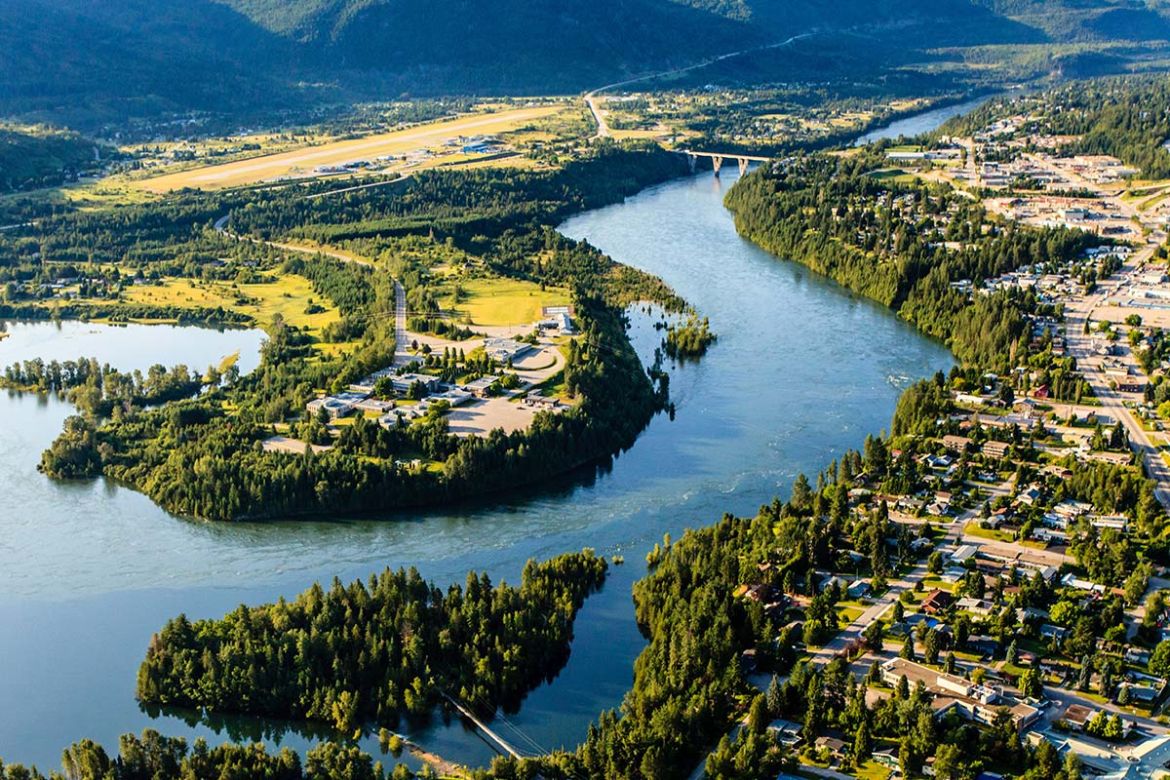
Before industrial development, the Columbia River supported a productive Salmon ecosystem.
Learn more
Following European colonization in the 19th century, intensive commercial harvesting—particularly through canneries established from the 1860s onward—placed increasing pressure on Salmon populations. By the early 20th century, overfishing, habitat degradation, and river modification had already contributed to significant declines.
A defining turning point came with the construction of the Grand Coulee Dam (built 1933–1941), which permanently blocked Salmon migration to the upper Columbia River, including spawning grounds in what is now British Columbia. This single barrier eliminated access to over 1,000 miles of habitat and ended Salmon runs to the upper basin. While additional dams built in subsequent decades incorporated fish ladders or spillways in some locations, several major dams—including Grand Coulee—remain complete barriers.
Together with ongoing pressures from habitat alteration, hydropower development, and changing ocean conditions, these dams have led to long-term declines in Columbia River Salmon populations. Today, many runs are endangered or extirpated, and Indigenous-led and scientific restoration efforts are underway to reintroduce Salmon to parts of the upper Columbia for the first time in over 80 years.
This carving honours the story of Salmon in the Columbia River watershed and their role in sustaining life across the region. As a keystone species, Salmon transport marine nutrients deep into inland ecosystems, nourishing forests, wildlife, and waterways. Their decline has had cascading ecological consequences, altering entire food webs. Their return signals the potential recovery of these interconnected systems, as Indigenous Nations, scientists, and communities work together to restore balance and welcome Salmon home.
Cedar and Silver Maple
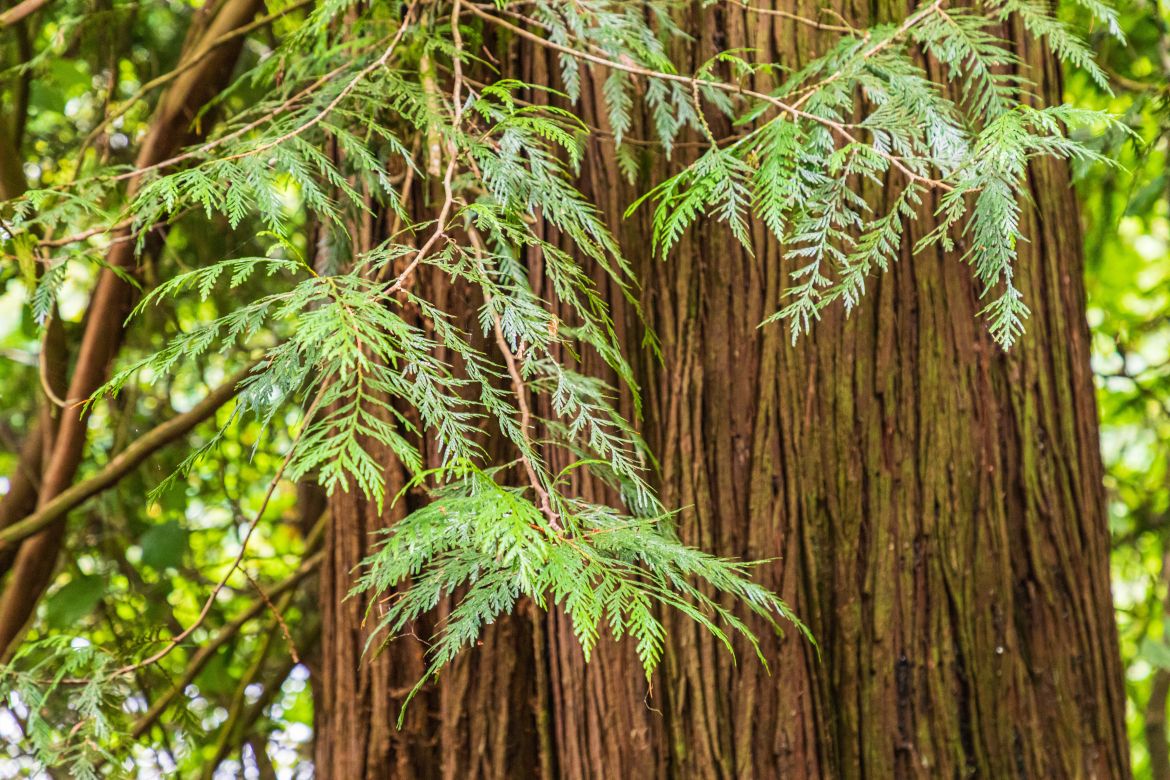
Coyote and two Salmon are carved from a silver maple tree. The two other Salmon are carved from a windfallen cedar tree.
Learn more
Coyote and the anterior two Salmon are carved from a silver maple tree, originally hewn near Nelson, BC and sourced from a mill outside of Salmo, British Columbia.
The posterior Salmon are carved from a windfallen cedar tree. The cedar tree was reclaimed from the 7 Mile Dam on the Pend d’Oreille River in Washington. Growing in the riparian area of the Salmo or Pend d’Oreille River, the tree benefitted from the nutrient-rich soil fed by composting Salmon carcasses. Those nutrients became part of the tree’s very structure — remarkably, these cedar salmon contain the genetics of wild salmon.
Coyote Stories
Many Nations have stories of coyote as trickster. Explore stories shared from local Nations below.
The Okanagan Nation Alliance story comes to us from the salmon restoration work that they've been doing: snkʼlip ɬə cxʷuysts iʔ qaqxʷəlʼx How Coyote Brought the Salmon.
A Meaningful Gift
Selkirk College is grateful to the Salmo Watershed Streamkeepers Society (SWSS) for generously donating this carving and for their vision to bring together artists, Nation partners and the college community to share the story of Coyote and the Salmon.
Donor story
This carving is a tangible rendition of the Indigenous origin story of Coyote bringing Salmon to Columbia River Nations. The story goes that Coyote—a bit of a scoundrel—brought Salmon up the River. As he met each Nation in his upstream journey, he offered them Salmon in exchange for the most beautiful women in their Nation. Those who made this exchange received Salmon.
Coyote is often seen as a unifying "deity" across many of the Columbia River Watershed Nations.
The Salmo Watershed Streamkeepers Society offers this remarkable piece of work to Selkirk College to encourage students to:
- Honour First Nations origin stories.
- Develop a relationship with the great ecological advantage of the reintroduction of Salmon into our Ecosystem.
- See the Coyote gift as a journey of collaboration and advantage for all.
- Begin to envision renewal, both in an ecological sense and in a social justice sense.
- Introduce or reinforce the ability of a great work of art to encourage feeling, sentiment, sensation, reaction, and response.
The SWSS is an award-winning charitable organization with 27 years of experience advancing ecosystem health through scientific research, education, restoration, monitoring, and partnerships. Its community outreach includes commissioning and sharing artwork that reflects ethnoecological themes, including this carving.
Thank you to the Nathan and Anna Fund for Peace and Reconciliation, which provided funding for the welcome gathering, interpretive signage, digital storytelling and the commission for the creation of the base. The fund supports projects furthering peacebuilding, pacifism, truth-telling, reconciliation and the strengthening of community relationships.